Eczema Journey: 4th Grade - The Year He Seemed Happier

Updated: 7 days ago
Part 6 of My Son's Eczema Journey
Fourth grade felt a little different.
His eczema was still there. We were still vacuuming constantly, watching what he ate, paying attention to the weather, and looking for anything that might make his skin more comfortable.
But he seemed happier.
By then, we had figured out that citric acid was a trigger for him, and we had gotten to a pretty good place with food. I wasn't constantly eliminating something new or wondering if there was another food we had missed.
His biggest triggers seemed to be heat, water, and even air.
That last one might sound strange if you've never lived with eczema.
A fan blowing on him could hurt. Air conditioning could hurt. Even the wind outside could hurt. When the skin on his neck, the backs of his legs, or his eyelids was open and irritated, air blowing across it could sting.
But it didn't only hurt. It could also make him itch. And once he started scratching, we could be right back in the cycle again - itching led to scratching, scratching damaged the skin, and the damaged skin itched even more. Something as simple as sitting beneath an air-conditioning vent or being outside on a windy day could start the whole process over again.
Water was just as unpredictable.
Chlorine made the pool pretty much off-limits because it stung his skin. Even the ocean could be a problem.
I remember taking a family walk with our dog near the beach one day. He was wearing shorts and decided to walk into the saltwater.
Almost immediately, his legs began burning.
We left.
We gathered everything up, went home, and rinsed and dried his legs until we could get him comfortable again.
By fourth grade, there wasn't a discussion about whether we had just gotten there or whether everyone else wanted to stay.
He hurt.
We went home.
I don't think we always handled things that way in the beginning. There had been times when one of us complained or showed our disappointment when eczema changed our plans.
But we were learning how to pivot.
More importantly, we were learning how to pivot without making him feel bad for needing us to.
Taking care of one another had become more important than the plan.
His eczema wasn't on his face nearly as much that year.
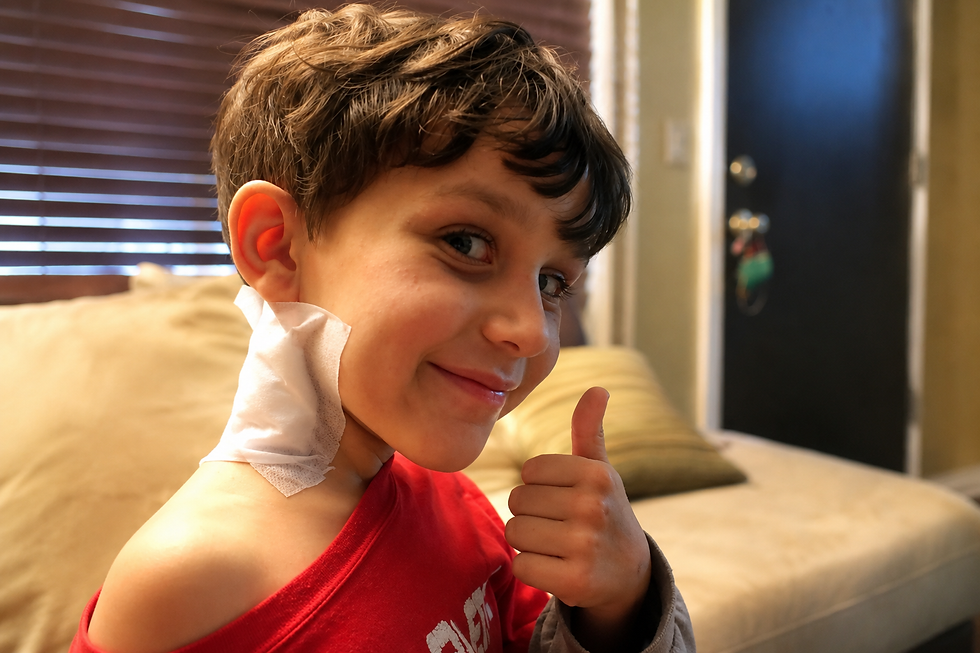
He still had occasional problems around his chin, eyelids and ears, and on his neck. His wrists, elbows, knees, lower legs and ankles were more commonly affected.
But not having it so visibly on his face seemed to make a difference. He was more receptive to going places.
He seemed more confident - not only in how he acted, but in what he was willing to do.
For a school project, the fourth graders had to choose someone they admired, dress like them, and give a presentation about their life.
My son chose R.L. Stine.
He had been independently reading Goosebumps books since kindergarten, and he loved them.
We dressed him in a black button-down shirt, oversized glasses, big fake eyebrows and fake moles. His display had Goosebumps books, a typewriter and all kinds of things related to R.L. Stine and his stories.
And then my son stood in the cafeteria in front of the entire fourth grade and taught other kids about someone he genuinely enjoyed.
He loved it.
Looking at those pictures now, I see a little boy willing to put himself out there again.
That year, he also asked if he could participate in our local Summer Solstice Parade with his art teacher and several other people. Their group was Steampunk themed, and he dressed in this elaborate costume with a hat, goggles, pointed ears and all kinds of accessories.
The important part to me now isn't the costume.
He asked to do it.
He also asked if he could try going to church again.
I took him a couple of times to a friend's church. He never really told me why he wanted to go. Not that he needed a reason. Maybe it was simply because his friend went there. Looking back, I sometimes wonder if he was looking for comfort.
After a couple of visits, when I asked if he wanted to go again, he said no.
He didn't really explain that either.
At the time, I thought some of the changes I was seeing in him were maturity. He was getting older. He was handling more of his eczema care himself. He didn't talk about it as much.
Looking back, I wonder if some of that was also the beginning of him internalizing more of what he was feeling.
I don't know.
Maybe it was both.
There were other little signs that he was growing up.
Coconut oil was still one of the things he liked best for his skin, but now he was becoming aware that it could make his hair look greasy or his face look oily.
So he became more sparing with it.
He would still visit the school nurse when he needed to, but he was becoming more capable of handling some things himself too.
Ice packs never went away.
Even today, he is constantly looking for a cold one.
Baths had changed too.
There were no more battles about taking them.
If his skin could tolerate a bath, he took one. If he had too many open scratches or wounds and the water was going to sting, he would wash himself another way.
We did what his skin allowed that day.
We also became better at figuring out ways to protect it.
We found athletic-style sleeves that could cover his wrists and arms. They protected his skin from air, helped keep him from picking at it, and gave him a way to cover his eczema when he didn't want other people seeing it.
But even those came with a tradeoff.
The synthetic material could make him hot and sweaty, which could trigger more itching. Bacteria could also become trapped in the material, so we had to replace them frequently.
We used neck coverings for some of the same reasons. They could protect his neck without requiring him to wear a hot hoodie, and sometimes we could wet them to give him moisture and keep him cool.
Cotton became especially important because it allowed us to cover his skin while still letting it breathe.
Sun was another balancing act.
We needed to keep him from getting sunburned because a burn would leave his skin dry and itchy, almost like adding another layer of eczema.
But sunscreen itself was a trigger.
So we needed to cover him from the sun without covering him so much that he overheated and sweated.
It seemed as though almost every solution came with another problem to consider.
By then, we were used to adjusting.
His sleep was still difficult, although it was a little better that year.
His attendance was a little better too.
I still let him stay home when he needed to. If he hadn't slept, his skin hurt, or he simply didn't feel comfortable going, I wasn't going to force him.
But more often, he wanted to go.
He also made a couple of good friends that year.
One of those friendships has lasted all the way to sixteen.
Interestingly, that friend would later struggle with eczema too, although neither of them could have known that when their friendship began.
His dad also got him an Xbox that year, and he fell in love with gaming. He began making friends online, including kids who lived in other states. He became particularly close with one of them, and eventually, when that friend's family came to California on vacation, we met them at Disneyland.
His world was getting bigger again.
And so was ours.
We went to see the dinosaurs at the Natural History Museum because he loved them. We went to the zoo. We went to the beach when his skin was having a good day.
We didn't wait for eczema to disappear.
We finally understood that the day we were waiting for—the day his eczema would simply go away—might never come.
Instead, we learned to take advantage of the good moments.
If he felt good and wanted to go somewhere, we went.
If he wanted to participate in something, we encouraged him.
And if we got there and eczema changed the plan?
We changed the plan too.
No blame.
No making him feel as though everyone else's good time had been ruined because his skin hurt.
We went home.
There would be another good moment.
Looking back, fourth grade feels like a year of relief.
Not because his eczema was gone.
It wasn't.
There were still restrictions. There were still things he couldn't do. I was still researching, still looking for ways to make him more comfortable, and still hoping I might find something that would finally make it stop.
I don't think I ever fully relaxed.
I don't think he did either.
But he seemed happier.
He had friends and one very good friend.
He wanted to participate again.
He was willing to put himself out there.
Some of his confidence seemed to be returning.
And after years of watching him suffer, seeing him happier made me happy too.
Fourth grade taught us something I think matters far beyond eczema.
Chronic illness may always be there. It may always create limitations and restrictions. There may always be things you have to consider that other families never have to think about.
But when a good moment comes, take it.
Go to the beach.
Go see the dinosaurs.
Put on the ridiculous fake eyebrows and tell an entire cafeteria full of fourth graders why you love R.L. Stine.
And if the moment ends sooner than you hoped, that's okay too.
Pivot.
Take care of one another.
Then wait for the next good moment and take that one too.
Because a life lived with chronic illness is still a life meant to be lived fully.
Those good moments become good memories, and sometimes those memories help carry you through the harder days. They give you hope. Because somewhere in the back of your mind, even when things get really tough, you know there will be days filled with fun and laughter again.
And sometimes, knowing those days will come is enough to help you through the ones that hurt.
Reflection
Living with chronic illness can teach you to wait.
To wait until you feel better.
Until the flare settles.
Until your body cooperates.
Until life feels a little more predictable.
But sometimes waiting for everything to be better means missing the moments when things are simply good enough.
Fourth grade taught us to notice those moments.
When my son felt good, we went. We went to the beach, saw the dinosaurs, participated in things he wanted to try, and let the day be whatever it could be.
Sometimes it lasted.
Sometimes we had to change our plans and come home.
Either way, the good moment still mattered.
We weren't grateful for the eczema or the limitations it placed on his childhood. We were grateful for the spaces between them—the moments when he felt good enough to simply enjoy being a kid.
And we learned not to waste them.
A Gentle Invitation
If you or someone you love lives with chronic illness, think about something you've been putting off until things are better.
Is there a smaller version of it you could enjoy on a good day?
Years before fourth grade, during a particularly difficult time with my son's eczema, we had a picnic on our living room floor. We spread out a blanket, made fruit salad and little sandwiches, added some chips, and had our picnic right there.
We couldn't always make life fit what we had planned.
So sometimes we made the plan fit the life we had.
And all these years later, that indoor picnic is a happy memory.
Maybe you can't spend an entire day at the beach, but you can watch the sunset. Maybe you can't manage a long outing, but you can take a short one. Maybe the picnic needs to happen on the living room floor.
And maybe you try something and discover halfway through that today isn't the day.
You can go home. You can change the plan. You can try again another time.
Adapting doesn't have to mean missing out. Sometimes the adapted version becomes a memory you treasure.
Take advantage of the good moments when they come, and give yourself permission to make them fit the life you have today.
What We Learned Along the Way
Take Advantage of the Good Moments
When someone you love lives with chronic illness, it can become easy to organize life around what they can't do.
We learned to pay attention to what my son could do that day instead.
If his eczema was calm enough and he felt good, we tried to take advantage of it. We stopped waiting for the perfect day or for eczema to no longer be part of the equation.
Some of those ordinary good days became some of our happiest memories.
You are always welcome here.
🌿WGG


Comments