Eczema Journey: 3rd Grade — From Cure to Care

Updated: Sep 22
Part 5 of My Son’s Eczema Journey
By third grade, we had settled into a routine.
That doesn't mean things were easy. It simply meant eczema had become part of our daily life.
We knew what each day would likely bring. We just didn't know how difficult that day would be.
We had become good at managing eczema, but not at stopping it.
Dr. Vic had once told us that many children outgrew eczema by around this age. I had held onto that hope for years. As third grade began, I realized we had quietly passed that milestone.
I wasn't ready to admit it, but a question had started creeping into the back of my mind.
What if he doesn't outgrow this?
That thought was devastating.
I kept researching. Every evening seemed to end the same way—with another article, another parent discussion, another suggestion someone swore had worked.
The problem was, by then we had already tried almost everything I could find other than light therapy.
I wasn't giving up.
I just didn't know where else to turn.
That summer before third grade, another chapter of our lives quietly ended.
My mother had moved to my brother's home.
I missed her deeply, but for the first time in years I could focus completely on my husband and our children. My daughter had started transitional kindergarten, and with both kids in school I suddenly found myself with something I hadn't had in a very long time.
Space.
Time to think.
Time to reflect.
Time to wonder where we had been and where we were going.
I volunteered in both of their classrooms, spent afternoons doing the things they wanted to do instead of planning our days around what Grandma was able to do, and slowly realized that our family was entering a new season.
Everything felt different.
I just couldn't name it yet.
This was also the year I began noticing changes in my son that had nothing to do with his skin itself.
He asked for a bed tent.
At first, I assumed he wanted a little privacy since he still shared a room with his sister. Later, I began to wonder if it had become a place where he could retreat when his skin felt especially uncomfortable—or where he could finally give in to the relentless itch without feeling watched.
The tent only lasted a few months.
It became too hot inside, and heat was one of his biggest triggers.
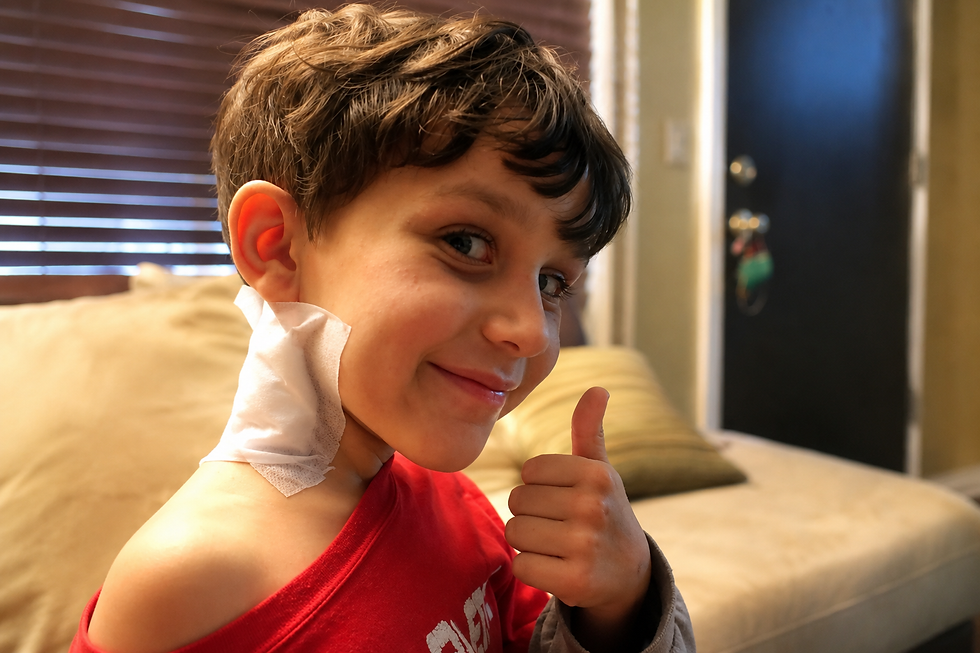
His eczema still affected his hands, arms, legs, neck, eyelids, ears, and chin much of that year.
He also developed several large bumps around his eyebrows, nose, and ear.
People noticed.
Adults in grocery store lines would ask if he'd been burned.
Some would unapologetically stare.
Others asked questions that probably seemed harmless to them but made him visibly uncomfortable.
He would quietly walk away from the conversation or move to the end of the checkout lane, looking anywhere but at the person speaking.
As his mother, I noticed something changing.
The comments weren't just hurting me anymore.
They were hurting him.
One afternoon at the park, another father walked up to me and asked loudly,
"All right, my kid's not gonna get anything from your kid, is he?"
Caught off guard, I simply answered,
"No. He has eczema."
After he walked away, my friend looked at me and said,
"I can't believe you didn't tell him off."
For years, my instinct had always been to explain. I thought that if people understood eczema, maybe they would become more compassionate.
Looking back, I realize I was learning something else.
Sometimes understanding someone's ignorance isn't the same as allowing it.
Sometimes your child doesn't need another explanation.
Sometimes they just need to know you're standing beside them.
We tried a new prescription that year.
Eucrisa helped some.
The problem was that it stung terribly when we applied it.
I left the decision to him.
When his eczema became especially severe, he would sometimes choose to use it. Most of the time, he decided the pain wasn't worth the small amount of improvement it offered.
He loved coconut oil instead.
It soothed his dry skin, and I appreciated that it also offered antimicrobial properties.
Something else had changed, though.
Until then, I measured progress by whether his eczema improved.
Now I began measuring it by something else too. Was he more comfortable? Did he sleep a little better? Did he feel a little more confident? Could we make one small part of his day easier?
Third grade taught me that there isn't always a cure. But there is almost always something we can do to ease someone's burden.
From that year on, I searched just as hard for ways to make his life easier as I did for a cure.
School changed for me that year too.
Before then, I worried about attendance.
I worried about missed assignments.
I worried about what teachers might think if he stayed home.
Ultimately, I usually let him decide, but I always felt caught between doing what I thought was expected and doing what I knew he needed.
This year, that changed.
If he hadn't slept because he had scratched all night...
If the weather was so hot I knew it would trigger his eczema...
If he woke up with a large patch on his face and simply didn't want the world staring at him that day...
I stopped worrying about what the school might think.
I started prioritizing what he was telling me about his own body.
I realized that protecting his physical and emotional well-being wasn't getting in the way of his education.
It was part of it.
Friendships also became harder.
He wasn't always chosen.
One day he quietly told me that he often felt lonely at school.
I told him about my own childhood after my best friend moved away and how lonely I had often felt too.
Years later, both of us would be diagnosed with ADHD, and I would wonder how much of his loneliness came from that, how much came from eczema, and how much simply came from being a little boy trying to find his place.
The truth is, I don't think we can separate those things. They were all woven together, each shaping the childhood he was living.
At home, he was still himself.
Maybe a little quieter.
Maybe sharing a little less.
I wasn't sure if it was simply age or something more.
But there was still one place where his confidence shined.
The talent show.
He sang Old Town Road, and the crowd cheered as he began.
They sang right along with him.
They applauded loudly.
He was adorable.
I couldn't have been more proud.
Looking back, I wonder if this was his last talent show because he was simply growing older, becoming more aware of his eczema, or a combination of both. Either way, he never wanted to enter again.
I missed seeing him on that stage, but more than that, I grieved for the carefree little boy who had once been so eager to climb onto it.
The biggest lesson I learned wasn't about eczema.
It was about chronic illness.
Until then, I believed that if I just kept searching long enough, I would eventually find the thing that fixed it.
Third grade taught me something much harder.
Sometimes there isn't a cure waiting just around the corner.
Sometimes your greatest responsibility isn't finding the answer.
It's helping someone live well while you're still searching for the cure.
From that point on, I stopped asking only,
"How do I make this go away?"
I also began asking,
"How do I make his life easier while it's here?"
Those are two very different questions.
And learning the difference changed both of us.
Reflection
There is a unique kind of grief that comes when we realize something may not have a quick solution. Whether it's a chronic illness, a caregiving role, or another challenge we never expected, we often begin by asking, "How do I fix this?"
Sometimes the answer doesn't come.
Or at least, not as quickly as we hoped.
That doesn't mean we've failed. It doesn't mean hope is gone. Sometimes it simply means our role begins to change. We continue looking for answers, but we also begin asking a different question:
"How can I make today a little easier?"
Often, those small acts of care become just as meaningful as the search itself.
A Gentle Invitation
Think of a situation in your own life where you've been focused on finding the perfect solution.
Has there been a time when simply making life a little easier was also a form of progress?
What brings comfort to you or someone you love, even if it doesn't solve the problem?
Are there expectations you can gently release so you can focus more on well-being than perfection?
What is one small change you could make this week that would lessen someone's burden—including your own?
Sometimes healing isn't found only in the outcome.
Sometimes it is found in how we care for one another along the way.
What We Learned Along the Way
Hope and acceptance can exist together.
Caring for someone isn't only about finding a cure—it's also about making today a little more manageable.
Comfort is never "just comfort." Small moments of relief matter.
Listening to what someone's body is telling them is an act of trust.
Progress doesn't always look like getting better. Sometimes it looks like sleeping a little longer, smiling a little more, or feeling understood.
Children often notice more than we realize. Protecting their emotional well-being is just as important as protecting their physical health.
We can't always change the challenge someone is facing, but we can change how supported they feel while facing it.
You are always welcome here.
🌿WGG


Comments