Eczema Journey: Kindergarten — When It Became More Than a Rash

Updated: Sep 22
Part 2 of My Son's Eczema Journey
As kindergarten progressed, so did the eczema.
It got worse and worse.
It was now on the back of his neck, behind his ears, and under his earlobes.
We continued going back to the pediatrician. Each time, there was more advice, a different ointment, another medication to try.
This time, he suggested something simple.
Use ice packs when it itches—to help prevent the scratching and the damage that comes with it.
At the time, it seemed almost too simple.
But it would become one of the most valuable pieces of advice we were ever given.
Even now, years later, my son still reaches for ice packs during a flare-up.
Our freezer is full of them—different sizes, always ready.
Around this time, our pediatrician, Dr. Vic began teaching us words we had never heard before.
Triggers.
Flare-ups.
He explained that a trigger was something that caused the eczema to worsen and that finding those triggers could sometimes make a big difference.
He encouraged us to pay attention.
To trust our instincts.
Nobody would spend more time observing our son than we would.
Nobody would notice the small patterns sooner.
That advice would stay with me for years.
Dr. Vic also gave us something else.
Hope.
He told us he had seen children whose eczema became much worse before eventually improving. Some had even outgrown it by the time they were seven or eight years old.
I held tightly to that possibility.
But no combination of medicine, ointment, cream, or lotion seemed to stop the progression.
That year, it spread.
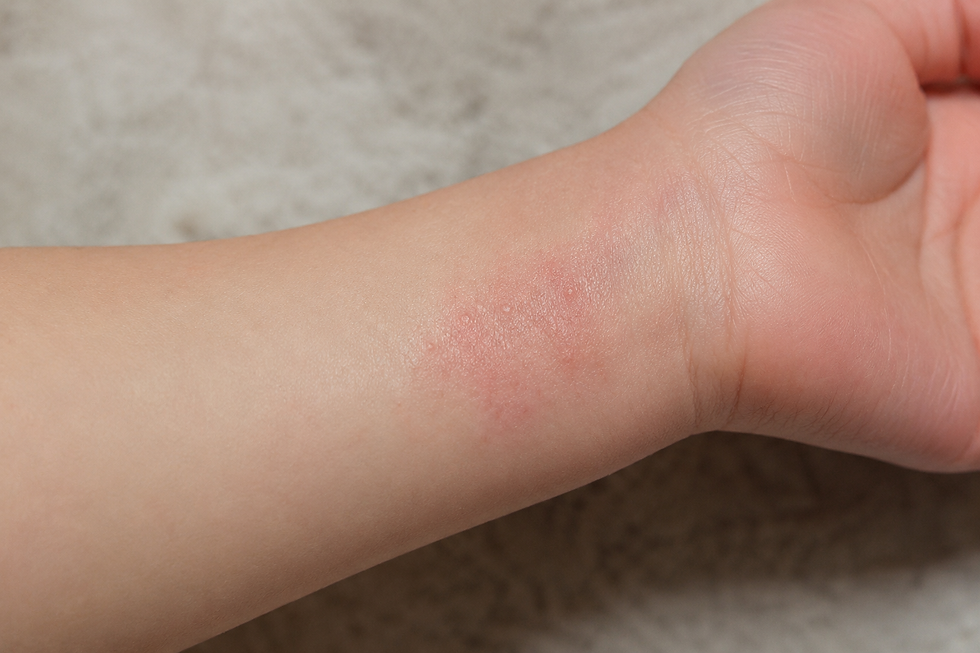
What had started on his wrist moved to the tops of both of his hands.
His small earlobes began to separate where they connected to his face.
The rash behind his ears became part of the rash on the back of his neck—no longer separate areas, but one continuous place that never seemed to fully heal.
Looking for anything that might help.
Again and again, I was led to the possibility of food allergies.
So I started keeping a log of everything he ate.
There were patterns that seemed like they might mean something—but never clearly enough.
Tangerines.
Sometimes strawberries.
At times, even chocolate.
Maybe tomatoes.
They would seem to trigger something... but not always.
We used organic produce and tried to keep everything healthy.
Nothing was consistent enough to feel certain.
I reached out to his teacher, wondering if something in the classroom environment might be making it worse.
They assured me they were using organic cleaning products—things like Simple Green.
So I let that possibility go.
And I kept searching.
Looking back, I realize how urgent the search had become.
When your child is suffering, you become desperate to find answers.
I kept believing I would eventually find the thing causing it.
The allergy.
The trigger.
The missing piece.
I just hadn't found it yet.
By this point, it was beginning to affect more than just his skin.
It was affecting his sleep.
Many nights, he would wake up itching.
Once the busyness of the day quieted and he was alone in his room, it would begin.
Or at least, that's what I thought at the time.
Later, I came to understand something different.
The itching hadn't started at night.
It had been there all day.
He had simply been holding it in.
At school, around other kids, and often around us, he was trying not to scratch—trying not to draw attention, trying not to be seen.
Looking back, there is another thing I understand differently now.
At the time, my husband and I often told him not to scratch.
"Just leave it alone."
"Try not to scratch it."
It seemed simple enough to us.
We thought we were helping.
What we didn't understand yet was that eczema itch is not ordinary itching.
It can become relentless.
All-consuming.
I sometimes wonder if our constant reminders unintentionally added another layer to what he was already carrying.
The itching.
The discomfort.
And the growing awareness that other people were beginning to notice.
Around that time, he began asking for hooded shirts.
The air hurt the tender skin on the back of his neck.
No matter whether it was hot or cold.
The skin was raw and open from scratching, and even something as simple as moving air could be painful.
I found him several lightweight t-shirt hoodies so he could feel more comfortable.
I volunteered in his kindergarten class every week, helping with art projects.
More than once, children asked me what was on his wrist.
Simple questions.
Curious questions.
Most of the time they asked when he wasn't standing there beside me.
What I do know is that this was one of the first signs that other people were noticing too.
But what I remember most about kindergarten is that eczema still didn't define him.
Not yet.
He was one of the most confident children in his class.
Comfortable talking to adults.
Comfortable talking to other children.
Funny.
Outgoing.
Verbally gifted, as we had been told more than once.
He was also regularly reading Goosebumps books meant for children several years older than he was.
At the time, it seemed perfectly ordinary.
He was simply our son.
That year, our elementary school held its annual talent show.
The show was intended for older students, but my son wanted to participate.
So he asked his teacher himself.
And the school made an exception.
Wearing a fedora, a bright blue button-up shirt, and a huge smile, he walked onto that stage in front of the entire school and sang "You Are My Sunshine."
He wasn't nervous.
Not even a little.
The audience cheered and laughed because he was so adorable—and honestly, because he was good.
But he never lost focus.
He just kept singing.
Looking back, I think that may be what I remember most.
Not the eczema.
Not the searching.
Not the sleepless nights.
But the little boy who still believed he could do anything.
By the summer before first grade, the eczema had spread again.
This time to the backs of his knees.
A very tender place.
And our journey was about to become much more complicated.
Reflection
Looking back, kindergarten was the year we realized this wasn't simply a stubborn rash that would eventually disappear on its own.
It was the year we learned new words, searched for answers late into the night, and began paying attention to patterns we had never noticed before.
It was also the year I began to understand that living with eczema involved much more than caring for skin. It affected sleep, confidence, comfort, and eventually how my son saw himself.
Yet when I think back on that year, I don't remember the ointments or food logs first.
I remember the little boy in the fedora, standing on a stage without an ounce of fear.
Sometimes the most important thing to remember about a diagnosis is that it is only one part of a person's story.
A Gentle Invitation
Think about a challenge you or someone you love has faced.
Now think about the person behind that challenge.
What makes them laugh?
What lights them up?
What are they proud of?
A diagnosis, a hardship, or a difficult season may shape part of a life, but it never tells the whole story.
This week, take a moment to notice the person beyond the struggle.
What We Learned Along the Way
• Ice packs can be incredibly helpful. What seemed like simple advice from our pediatrician became one of the most effective tools we ever found for managing intense itching. More than a decade later, we still keep a freezer full of them.
• Trust your instincts. Nobody spends more time observing your child than you do. Pay attention to patterns, even when they don't make sense yet.
• A flare-up is a period when eczema suddenly becomes worse. More redness, more itching, more inflammation, or more affected skin. Understanding the language helped us better understand what we were experiencing.
• Food logs can reveal clues. They don't always provide answers, but they can help you identify patterns that might otherwise be missed.
• Be careful with your words. We often told our son not to scratch because we thought we were helping. Looking back, I understand that eczema itching is not a matter of willpower. What feels like encouragement to us can sometimes feel like criticism or shame to a child who is already struggling.
• Children often hide more than we realize. We assumed the itching started at night. In reality, he had likely been fighting it all day and only allowed himself to give in when he was finally alone.
• Eczema affects more than skin. Even in kindergarten, it was already affecting sleep, comfort, and confidence long before we fully understood the impact.
You are always welcome here.
🌿WGG
Comments