Eczema Journey: 1st Grade — The Year He Found His Voice

Updated: Sep 22
Part 3 of My Son's Eczema Journey Series
He kept getting worse over the summer.
By the time first grade started, everyone at school was wearing shorts and T-shirts.
My son was wearing pants and long-sleeved hoodies.
That alone drew attention.
The hoodies had originally been about comfort.
The air hurt the tender skin on the back of his neck.
But by first grade, they had become something more.
A way to cover the areas that had spread.
A way to feel a little less exposed.
A few days went by where temperatures reached close to 100 degrees.
One morning, as I was walking in to volunteer with my mother and daughter, the principal stopped me.
She asked—in a tone that felt more accusatory than concerned—why my son was wearing hoodies in such hot weather.
That it probably wasn't good for him.
I was caught off guard at first.
Then almost instantly, I felt anger rise.
She saw a child dressed too warmly.
I saw a child trying to make it through the day.
I explained that the hoodies were his choice.
That they made him more comfortable.
That was enough for me.
Not long after, the school nurse called.
She asked if there was anything they could do to support him.
I told her about the ice packs—how helpful they had been when the itching became too much.
They made sure he always had access to them.
They also kept a large jar of coconut oil for him, since that had become his preferred way to soothe the dry patches.
The nurse asked if she could talk with him.
I said yes.
A few days later, she called me back.
My son had shared that he was tired of the staring.
Tired of the questions.
Tired of feeling different.
The nurse suggested something unexpected.
What if he explained eczema to the other first graders?
She thought that if they understood it, they might stop focusing on it.
When I talked with him about it, he immediately liked the idea.
I asked if he wanted me to be there.
"No Mom," he said. "I can do it."
Part of me wished he had wanted me there.
But a much bigger part of me was proud of the confidence behind those words.
So I let him do exactly that.
The nurse took him from classroom to classroom.
Four first-grade classes.
Nearly ninety children.
He stood in front of his peers and explained eczema.
Later, he told me he explained what eczema was and then let the other children ask questions.
For a six-year-old, that was no small thing.
And it worked.
For a long time afterward, he talked about how different things felt.
The staring decreased.
The questions slowed down.
The other children seemed to understand.
And because they understood, they accepted it.
He could just be a kid again.
Outside of eczema, first grade was also the year Legos took over our house.
Not the simple sets designed for his age.
Complex sets.
Sets meant for much older children.
Once he discovered them, he was hooked.
I would often help sort the pieces into piles while he built.
Hours would pass.
Sometimes it felt like the only thing capable of pulling his attention away from the itching.
He was also becoming someone I could depend on.
Around that same time, my mother was beginning to need more supervision.
Not long before, she had wandered away with my young daughter during an outing, creating one of the most frightening moments of my life.
So when her foot began hurting badly during another outing and she couldn't make it back to the car, I felt torn.
Someone needed to stay with her.
Someone needed to get the car.
"I've got this, Mom," he said.
While my daughter and I hurried ahead, he sat with his grandmother, talked with her, and made sure she didn't become worried while we were gone.
When I returned, everything was fine.
Looking back, I can see so much of the young man he would become in moments like that.
But as first grade progressed, so did his eczema.
His existing patches remained.
And new ones appeared.
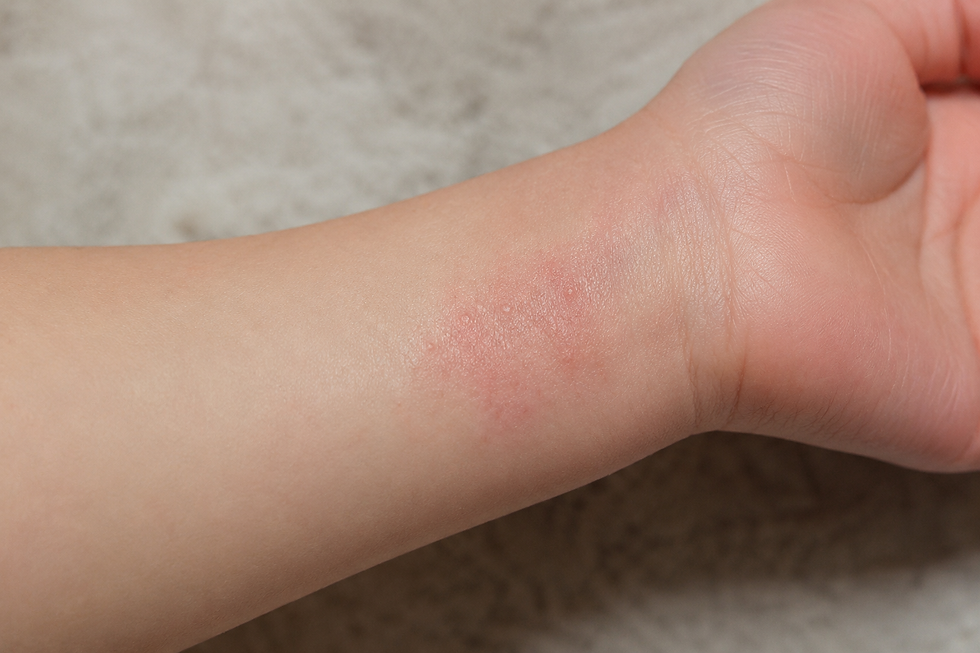
His forearms flared.
Then his ankles.
Then his shins and calves.
Then his knees.
His skin seemed to be losing ground faster than we could keep up.
What I saw now was no longer a small, persistent rash.
It was a child who was suffering.
And still, he went to school every day.
He held it together.
Even when he was uncomfortable.
Even when he was in pain.
At home, things were changing too.
He rarely wanted to take baths.
The water hurt.
His pediatrician, Dr. Vic, reassured me that washcloth baths were okay if soaking caused pain.
He continued to encourage us to trust our instincts.
He believed us when we noticed patterns.
He supported the food logs.
He suggested eliminating detergents, fabric softeners, and unnecessary chemicals.
Most importantly, he continued to give us hope.
He still believed my son might outgrow it.
I wanted desperately to believe that too.
That summer before first grade, I changed almost everything in our house.
Detergents.
Cleaning products.
Soaps.
Fabric softeners.
Anything I thought might be contributing.
Some changes helped.
None solved the problem.
Then came the skin infections.
The scratching created openings in the skin.
The infections created more itching.
The itching led to more scratching.
It became a cycle.
One infection in particular frightened me.
A swollen, painful bump developed behind his knee.
It became so painful he could barely bend his leg.
That was the moment I knew we needed more help.
We went to see a dermatologist.
He prescribed oral antibiotics and a steroid cream.
The antibiotics cleared the infection.
The steroid cream made everything worse.
Around the same time, we were told to try bleach baths and apple cider vinegar baths to help prevent the widespread infections.
My son said they stung.
I believed him.
At first, I wanted so badly to help that I occasionally tried to sneak them into the bathwater anyway.
He always knew.
And it created something I hadn't expected.
A loss of trust.
That experience taught me something important.
This wasn't my journey.
It was his.
It was his body.
And he deserved a voice in what happened to it.
Eczema left all of us feeling powerless.
I wanted so badly to fix it. To make it better. To find the answer.
But I slowly began to realize that while I couldn't give him control over his eczema, I could give him a voice in how we navigated it.
Allowing him to tell us what hurt, what helped, and what he was willing to try gave him something he desperately needed—a sense of ownership in a journey that belonged to him.
Looking back, empowering him to participate in his own care became just as important as any medication or treatment we tried.
Before first grade was over, another dermatologist suggested allergy testing.
We went through with it and learned that he was allergic to dust mites and mold.
It helped explain why the itching seemed worse at night.
But the testing itself came with something we hadn't expected.
His back had never been one of his problem areas.
After the testing, it became one.
The flare spread across his entire back and eventually wrapped around his torso.
What began as a reaction became an eighteen-month flare.
It was one of those moments where something meant to help made everything harder.
Around this same time, I was vacuuming his bed every day.
The amount of skin accumulating from the scratching had become impossible to ignore.
Learning about the dust mite allergy helped me understand why.
Skin feeds dust mites.
Dust mites worsened the eczema.
The cycle continued.
I invested in a bed vacuum with a special light designed to help reduce dust mites and added it to the growing list of daily routines.
Then something else began to come together.
For months, I had been keeping food logs and notes.
The same things kept appearing.
"Sometimes strawberries. Maybe tomatoes. Sometimes chocolate. Tangerines. Simple Green. Various candies."
The problem was that none of them pointed clearly in the same direction.
Some were foods.
One was a cleaning product.
Some seemed to trigger flares consistently.
Others only occasionally.
I couldn't make sense of it.
Over and over, I searched different combinations, looking for answers.
I tried every variation I could think of.
Then one day, I searched that list together.
"Sometimes strawberries. Maybe tomatoes. Sometimes chocolate. Tangerines. Simple Green."
That particular search revealed something none of the others had.
What those things had in common.
Citric acid.
Tangerines naturally contain it.
Organic strawberries are often washed in citric acid solutions after harvesting.
Some cocoa beans are fermented using citric acid.
Simple Green contains citric acid as one of its primary ingredients.
For the first time, I wasn't looking at five separate possibilities.
I was looking at one connection.
One clue that tied them all together.
Removing citric acid turned out to be far harder than finding it.
It was everywhere.
Food.
Candy.
Cleaning products.
Shampoo.
Sometimes listed.
Sometimes not.
But once we began identifying and eliminating it where we could, things improved.
We also discovered something else.
Not all chocolate was a problem.
After a lot of reading and trial and error, we learned that Hershey's chocolate did not trigger him the way many other chocolates did because they did not use citric acid in their process.
It may sound like a small thing, but when you're eliminating foods one by one and watching your child lose more and more of the things they enjoy, finding something safe feels enormous.
It felt like a win.
A small one, perhaps.
But by then, we had learned to celebrate every victory.
It wasn't the whole answer.
There never seemed to be just one answer with eczema.
But it was one of the first discoveries that made a meaningful difference in his daily life.
One small yes.
When I look back on first grade now, I remember a boy whose eczema was becoming more severe.
But I also remember a boy who stood in front of ninety classmates and explained something difficult.
A boy who stayed with his grandmother when she needed him.
A boy who spent hours building worlds out of Legos.
The eczema was growing.
But so was he.
Reflection
This year taught me that some of life's hardest challenges cannot be solved all at once.
Sometimes progress comes through observation.
Patience.
Trial and error.
And learning to listen more carefully.
Have you ever faced a situation where there was no immediate answer?
How did you keep moving forward when you didn't know what would work?
What small victories helped you maintain hope along the way?
And is there someone in your life whose voice deserves to be heard a little more carefully today?
Sometimes growth begins not when we find all the answers, but when we learn to trust the process of discovering them.
A Gentle Invitation
Today, pay attention to something you may have been trying to fix.
Instead of immediately searching for a solution, spend a few moments simply observing.
Notice the patterns.
Notice what helps.
Notice what makes things worse.
Whether it is a health challenge, a relationship, a habit, or a situation you are navigating,
awareness often comes before understanding.
And if someone you love is struggling, consider asking a simple question:
"What does this feel like for you?"
Sometimes listening is one of the most powerful forms of support we can offer.
Small observations.
Small victories.
Small steps forward.
Over time, they often lead us farther than we ever imagined.
What We Learned Along the Way
• Skin infections can make eczema significantly worse. Scratching creates openings in the skin, which can allow bacteria to enter and create a cycle of infection, itching, and more scratching.
• Triggers are often discovered through patterns, not single events. Keeping food logs and notes helped us identify clues we might otherwise have missed.
• Trust your instincts. Dr. Vic often reminded us that no one would spend more time observing our son than we would. Parents notice things that may not be obvious during a short office visit.
• Sometimes the answer is not one thing, but several things. Detergents, cleaning products, environmental allergies, infections, food sensitivities, and skin care routines all played a role in our son's eczema.
• Children deserve a voice in their own care. Looking back, one of the most important lessons I learned was that helping and forcing are not the same thing. Listening to my son's experience became just as important as trying to fix it.
• Small victories matter. When eczema becomes part of everyday life, even something as simple as discovering a safe treat or finding one trigger can feel like a major win.
You are always welcome here.
🌿WGG

Comments